Thursday, February 8, 2018

SMD soldering using halogen bulb

I had soldered SMD components that comes in 1206 package using soldering iorn with less effort. But anything less than 1206 is very tough to do with the iron. Recently I saw a video in which a halogen lamp (head lamp of car) is used to de-solder SMD components. I thought I will give a try to solder with solder paste and halogen lamp. Here are the results.

Solder paste that comes in syringe.


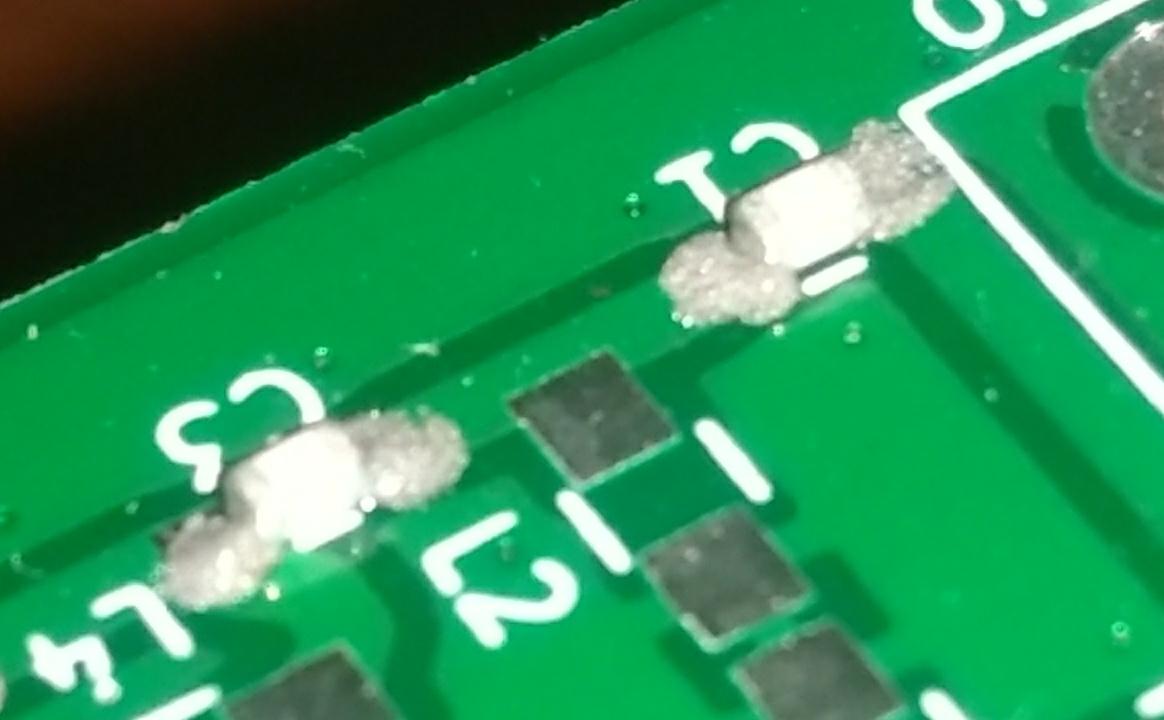
I used a small trimmer screwdriver to dab small quantity of paste to the pads on the pcb.Then I placed the SMD component using tweezers. The below picture shows SMD capacitor in 0603 package.
After placing all the components, heated the board using 12V 100W halogen lamp by holding it closely to the board for a minute, slightly moving around.

Here is the result. The quantity of the solder paste matters and it has to be just right.

A word of caution:
The halogen lamp gets really hot and needs to be handled very carefully. Also I had sunglasses while working as it gets really bright.

Monday, June 5, 2017

Powerpole connectors

I am trying to make a DC distribution box like Rigrunner. Rigrunner uses Anderson Powerpole connectors and it is becoming a standard DC interconnecting among the radio equipment. I am planning to make the whole set of equipment in the shack compatible with powerpole.


I bought these connectors off Aliexpress and found that the quality is not upto the mark.The ones from China has the geometry right, but the material and finishing is way off. It has rough, sharp edges and the material is too shiny and sticky and once you stack (sliding together) it, it is very tough to separate them (without bruising your fingers).  I decided to buy the original ones from Powerwrex.

Original connectors on the left side.

Thursday, September 29, 2016

Remote Control Panel for ICOM IC-M710

The IC-M710 is a rugged transceiver built for its purpose. Though it covers the whole HF band, it is not intended for use by a radio amateur. The user interface being its weakest point (for a Ham). The features that are sorely missed by a Ham being:

  • A Tuning dial - a true VFO tuning dial is missing.
  • A real CAT interface.
  • A headphone jack
For the last couple of weeks I was pondering over the idea of having a remote control unit that will address the above limitations. Also with the additional features:
  • A remote panel that can be used as a face plate for mobile operations.
  • Band selection, tuner commands
  • Rotator control
  • Frequency memories
  • RIT
  • CW keyer

Update 13/3/2017
1st prototype finished, can go remote on/off, VFO A/B, step size changes, delayed TX freq set, etc.

Sunday, January 24, 2016

Clone cable for Icom M710 radio

The cloning is done by the software supplied by Icom called ex1726. This is a program written for MS-DOS. Works on Windows 7 without any problems. However, it needs a true serial port - i.e. no USB-RS232 converters. I tried with different makes but did not succeed.

I made the cable for the radio and the schematic is as above. I used a separate power supply for the MAX232 to reduce the component count. It may be cumbersome as there will be lot of cables running around, but I could live with it as, cloning is not something you do daily. 

Wednesday, February 25, 2015

VHF Coverage in Bangalore-Kochi Route

I tested the VHF repeater coverage between Bangalore and Ernakulam on 21st and 23rd. The following repeaters are available en route:
Bangalore VU2TWO
Yelagiri VU2VCM
Yercaud VU2TCD
Kodaikanal VU2KOD
Nelliampathy VU2BCM
Idukki HEN
Kochi CHN

The Yercaud, Kodi and Nellampathi gives a very good coverage for over 100s of kms. The following is the longest distance that I could work.
Yercaud from Krishnagiri till Coimbatore
Nelliampathy from Sankari till Thrissur.

On 21st, I worked with VU2ZUB on TCD, VU3NKK on KOD and VU2PEY, VU2PPL on BCM


Tuesday, February 10, 2015

Good VHF Tropospheric Propagation

Today the VHF Propagation was so good that I was able to work with the Kodaikanal (VU2KOD at 300kms) and Nelliampathy (VU2BCM at 285kms) repeaters from Bangalore.

This is clearly a "Tropospheric ducting" propagation where the signals are refracted back to earth. This seems to be a regular phenomenon in South India especially found during this time of the year (feb).

Friday, February 6, 2015

ISS SSTV TX Decoded


Time: 1-FEB-2015 0550IST
Equipment:
Receiver - Baofeng UV-3R
Antenna - Fixed 3EL VHF Yagi (Luckily ISS was facing the antenna during the pass)
Sound Recorder - Android app installed in Moto G mobile phone (16KHz WAV format)
SSTV Decoder - MMSTV software in Windows XP (Settings - Auto Slant enabled, rest Default)